
Network X 2026 runs 13–15 October in Vienna. Register now — telcos and vendors will be there to talk about what's next for fibre.
Featured in This Article
David Tomalin, Group CTO, CityFibre
Alexander Brait, Head of Network & Infrastructure Strategy, A1 Telekom Austria
Across Europe, communication service providers (CSPs) are speaking out about how they are practically putting AI to work in their fibre networks. Rising AI-driven traffic, tightening capex, pressure to modernize ageing plant, and yes AI hype are prompting them to analyze if AI really saves money, will frontline teams use it, and how to approach data sharing and other challenges.
The good news is that telcos are using AI for a wide range of operational improvements, including to better predict and troubleshoot problems and reduce human error. CTO David Tomalin of CityFibre, a wholesale UK fiber network operator, discussed this on the panel AI in Fixed-Line Networks at Network X 2025 in Paris. CityFibre is using visual AI reviewing installation photos, and predictive tools flagging faults before they cause outages.
Tomalin’s panel also discussed some challenges such winning over field teams who see automation as a threat rather than a tool and closing the skills gap needed to integrate AI into legacy multi-vendor systems.
Some of the latest telcos thinking on AI in fibre networks is going to be shared at Network X 2026 in Vienna, October 13-15, on a panel featuring Alexander Brait of A1 Telekom Austria called Future-Proofing Fibre: GPON Standardisation, AI Integration & Convergence, as well as other fibre infrastructure issues (Register here).
Let’s look at the latest AI in fibre networks trends from telecom experts and from recent conversations with CSP infrastructure executives.
Top Telcos Issues With AI in Fibre Networks
- Can operators actually prove AI pays for itself? Telcos are already saving Opex costs using AI to troubleshoot problems, reduce error, and speed up installation times.
- Will frontline teams actually adopt it? Smart telcos are spending time educating their infrastructure teams and partners on using AI.
- Who controls the data, and who gets to see it? Sharing with aligned wholesale partners is one calculation; sharing outside that circle, where it aids a competitor, is another.
What does the research show about AI impact in carrier fibre networks?
Data and interviews of telco executives show they are bullish on the potential of using AI to improve their fibre networks. And that will be important because of their big worry that their networks will not be able to scale with the increased bandwidth expected from AI-driven traffic.
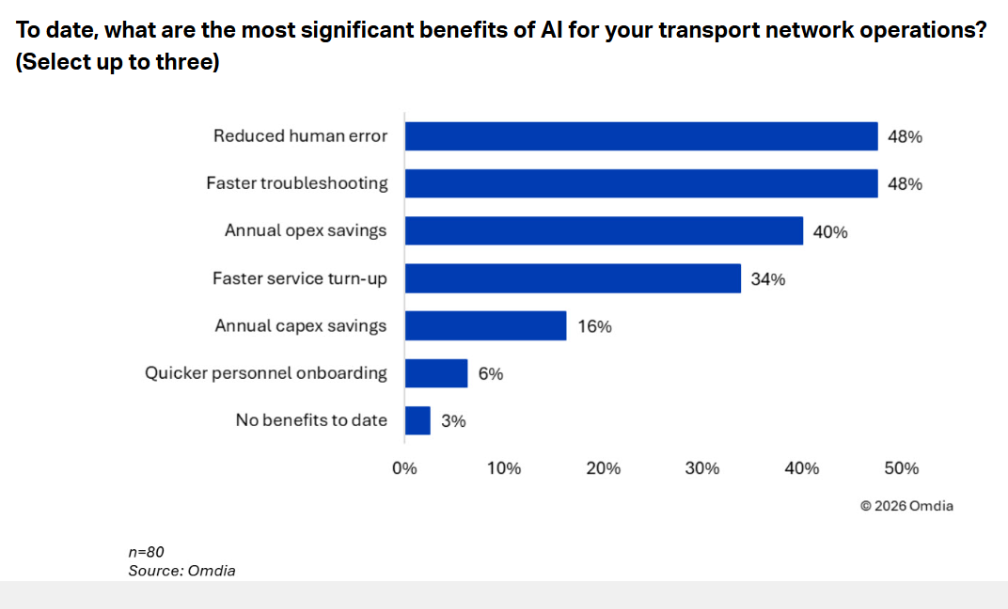
AI is moving from pilot to routine in transport network operations. In an Omdia survey of 80 CSPs, run with Ciena and Cisco in November 2025, 12% said AI is already a routine part of daily transport-network operations and planning, and a further 24% expect that within a year. The leading benefits operators cite are fewer human errors and faster troubleshooting (48% each), followed by opex savings (40%). (Omdia/Ciena, Mar 2026).
Network Optimization and Performance Monitoring. Heavy Reading/Omdia analyst Sterling Perrin notes in this report that telcos are using digital twins (virtual copies of the physical network), potentially to validate the use of Agentic AI recommendations before they are implemented in a live network. Use of digital twins was critical for network optimization and performance modeling.
Optical networks aren't ready for increased AI-traffic demands. In an August 2025 survey of 77 fixed, mobile, converged, and cable network operators by Heavy Reading and Ciena, only 16% called their optical networks “very ready” for AI; 40% said they were only “somewhat ready,” with much work remaining, and 5% said their networks weren't ready at all. (Telecoms.com, Aug 2025) Capex constraints and network management complexity were the CSPs leading barriers to AI readiness, the survey said.
Where are CSPs are using AI to drive cost savings in fibre networks?
All panelists on the AI in Fixed-Line Networks session, including Tomalin, Jeremy Chelot, CEO of Netomnia (a UK fibre network), and Dr. Sunil Piyarlall of Openserve (a fibre wholesaler in South Africa) agreed that AI is already delivering significant cost savings in infrastructure operations, particularly in build‑out, installation, and maintenance.
CityFibre’s Tomalin talked about shifting from sample‑based checks to 100% automated quality assurance has reduced rework, accelerated contractor payments, and improved first‑time‑right performance using an AI-powered vision platform.
In a case study published by IQGeo, CityFibre used to rely on manual audits by field engineers and contractors. But managers reviewed just 20% of installations, spending up to 60 minutes per audit and resulted in discrepancies between field data and system records.
Now CityFibre’s engineers capture fibre installation images before and after their work. The platform analyzes every photo in real-time to ensure stringent quality standards are met, flagging any deviations instantly. The result was a 92% decrease in QA time with AI automatically checks 100% of photos, leaving only problematic cases for human review. The system now catches installation mismatches in real time, not after a fault.
Neil McRae, CTIO of CityFibre, also talked to TelecomTV about how AI is allowing network engineers to speed up installations by using voice to check-off key installation tasks vs. time-consuming form filling on iPads. He also talked about AI to improve processes. “I think that everything we do in telco there will be an AI or old fashioned automation opportunity to improve the experience,” McRae said.
The Network X panel agreed that AI‑driven network observability is getting better. Operators are using performance data to identify micro‑faults, predict degradation, and schedule proactive maintenance, for example, replacing filters before they impact service quality. However, group emphasized that AI’s effectiveness is constrained by data availability and quality.
Will telco teams actually adopt AI for use on fibre networks?
A key challenge identified by the Network X panel were skills shortages and the complexity of integrating AI into legacy, multi-vendor networks. Operators building their own OSS/BSS stacks to move faster are concerned that every new AI capability can theoretically touch the entire system architecture.
These operators also noted that engineers may perceive automation as a threat. Reframing AI as a tool that improves efficiency and earnings such as faster payment cycles for contractors who met quality thresholds confirmed by AI was suggested.
McRae, CityFibre's CTIO agreed. “I think the biggest challenge is mindset,” he told Telecom TV. That's why CityFibre built an internal AI hub on Microsoft Copilot — a low-risk way in for CityFibre employees to start learning about AI.
Who controls the AI data and who gets to see it?
Tomalin says CityFibre shares data as broadly as its business model allows: the more it normalizes and shares, the better the models get for everyone. But he's clear about the boundary. CityFibre is a wholesale, open-access network, so it only wins when its ISP partners win; sharing performance data with them is an easy call.
Some on the Network X panel argued a neutral body should manage shared training data, particularly the visual data from installations, so the whole industry benefits from better models; others treated their operational data as a sovereign competitive asset, not something to pool. They agreed that AI's usefulness depends entirely on the robustness of the data feeding it and that’s an ongoing challenge (Network X)
What's next for carriers at Network X 2026?
These same concerns return to the stage at Network X 2026 in Vienna — this time with a carrier voice from the host market. The panel, Future-Proofing Fibre: GPON Standardisation, AI Integration & Convergence, runs in the Fibre track on Tuesday, 13 October, 16:05–16:45.
It's moderated by Dan Grossman of NetAccess Futures, with Eric Joyce of Adtran, Burhanettin Takanay of Argela, and Alexander Brait of A1 Telekom Austria, which operates Austria's largest FTTH network. It invests roughly €400 million a year across more than 80,000 kilometres of fibre, and it's run GPON and XGS-PON in parallel since 2023.
The session picks up where Tomalin and the 2025 panel left off. Topics include combo PON strategies for moving from GPON to XGS-PON without disrupting service, and the right balance of fibre, coax, and wireless for different rollouts. AI's role in driving symmetrical bandwidth demand is also on the agenda, alongside “mini cloud in the house” concepts for privacy-conscious customers.
Network X 2026 runs 13–15 October at VIECON, Vienna: more than 5,500 telecom leaders from fibre, mobile, Wi-Fi, data centre, and optical networking. View the agenda and register to hear how carriers such as A1 Telekom Austria are answering these questions in practice.
FAQs: AI in European Fibre Networks
Is AI already saving money for fibre networks in Europe?
Yes, in specific areas. UK fiber wholesale network CityFibre uses computer-vision checks to inspect installations. It has moved from spot-checks to full coverage without adding headcount. Savings are concentrated in installation, maintenance, and operations.
What's the biggest obstacle to wider AI adoption among European carriers?
Data governance could be an issue. Operators want to share more network data to train better models, but cross-border rules and GDPR slow it down. Some executives are suggesting the need for a trusted neutral party to hold shared data.
Where can European telecom leaders discuss AI and fibre convergence in person?
Network X 2026 in Vienna hosts the panel Future-Proofing Fibre: GPON Standardisation, AI Integration & Convergence on Tuesday, 13 October, 16:05–16:45, featuring A1 Telekom Austria, Adtran, and Argela. View the session and register to join the conversation.
About the Author
Christopher Lycett is the Event Director of Network X, which he launched in 2022, as well as 5G World, Broadband World Forum, Telco Cloud and the Cable Next-Gen events.